









Caring for an aging parent is rarely split down the middle; more often, one adult child becomes the person who answers every late-night call, schedules every appointment, and absorbs every cost. To understand how that imbalance forms and what it does to families, Bay Alarm Medical surveyed 1,008 U.S. adults who share or once shared caregiving for a parent age 65 or older, spanning four generations.
The findings reveal where the work piles up, what siblings fight about most, and how often an uneven load doesn’t just strain a relationship but ends it. For anyone juggling a job, their own family, and a parent’s growing needs, the numbers will feel all too familiar.
Key Takeaways
- Despite having siblings available to help, 43% of adult children say they have become the family’s default caregiver.
- The average caregiver says they shoulder 53% of their parent’s care responsibilities.
- Daughters do the heavy lifting: 46% say a daughter carries the hands-on caregiving, nearly three times the 17% who say a son does.
- The No. 1 source of sibling conflict is money, cited by 36%, ahead of the time and effort imbalance at 26%.
- 69% have fought with a sibling over an aging parent’s care, and among them, half (50%) say it now plays out in the family group chat.
- 18% of adult children have already lost a sibling relationship to caregiving, and 28% would be willing to cut a sibling off over a parent’s care.
- Nearly half of caregivers (47%) feel resentment toward a sibling over an unfair caregiving load.
The Default Caregiver: How One Sibling Ends Up Carrying the Load
On paper, caregiving looks like a team effort. In practice, the responsibility tends to settle squarely on a single set of shoulders.
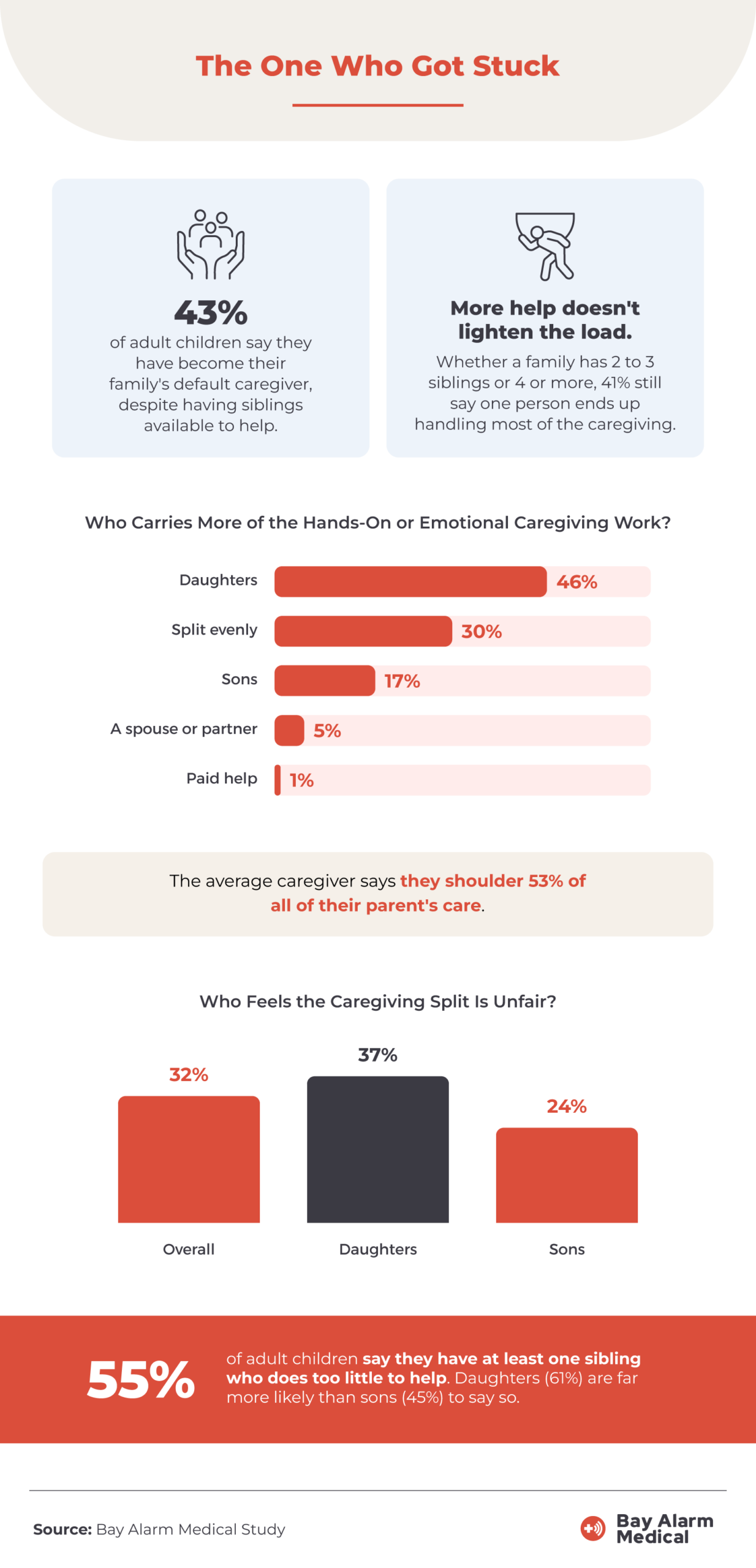
Even with brothers and sisters able to pitch in, 43% of adult children said they have become the family’s default caregiver. That likelihood shifted with age: Gen Z were the least likely to carry it alone at 34%, while Gen X were the most likely at 47%.
The imbalance showed up in the math, too. The average caregiver said they shoulder 53% of their parent’s care responsibilities, which was more than half the work falling to one person, even when help is theoretically available.
Gender plays an outsized role in who steps up. Forty-six percent of respondents said a daughter carries the hands-on caregiving, nearly three times the 17% who point to a son.
What Sparks the Fight: Money, Time, and the Family Group Chat
Disagreements between siblings rarely begin with the big philosophical questions of care. They tend to ignite over dollars, hours, and who is pulling their weight.
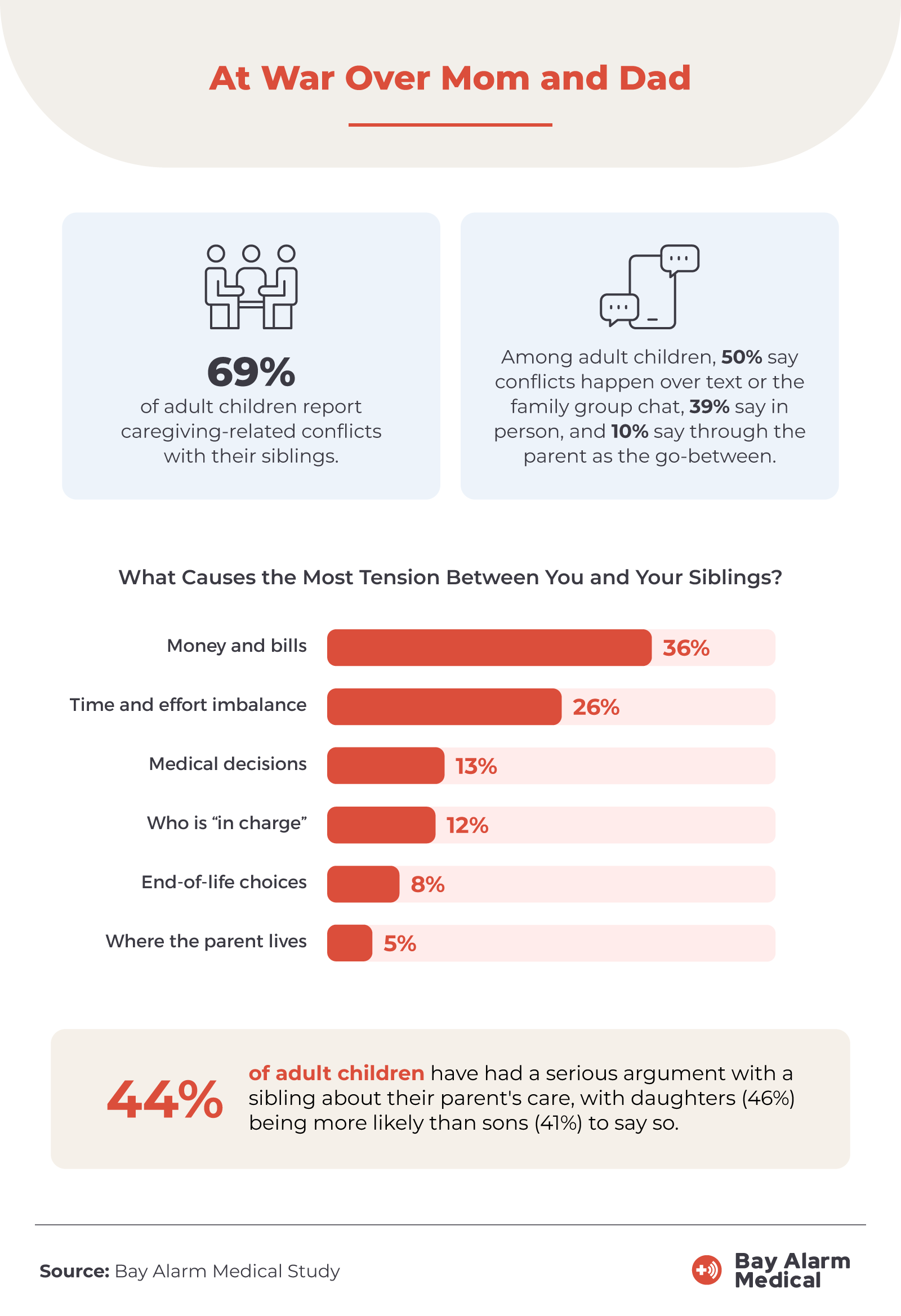
When siblings clash, money leads the way. It was the No. 1 source of conflict at 36%, ahead of the time and effort imbalance at 26%.
Younger generations felt the financial friction most sharply. Forty-two percent of Gen Z named money as the top trigger, compared with 40% of millennials, 31% of Gen X, and just 19% of baby boomers. Sons were also more money-focused than daughters, at 42% versus 32%.
These conflicts were both widespread and increasingly public. Sixty-nine percent fought with a sibling over an aging parent’s care, and among them, half (50%) said the argument now plays out in the family group chat.
When Resentment Hardens Into Estrangement
An unfair share of the work leaves a mark that outlasts any single argument. For some families, it reshapes the relationship permanently.
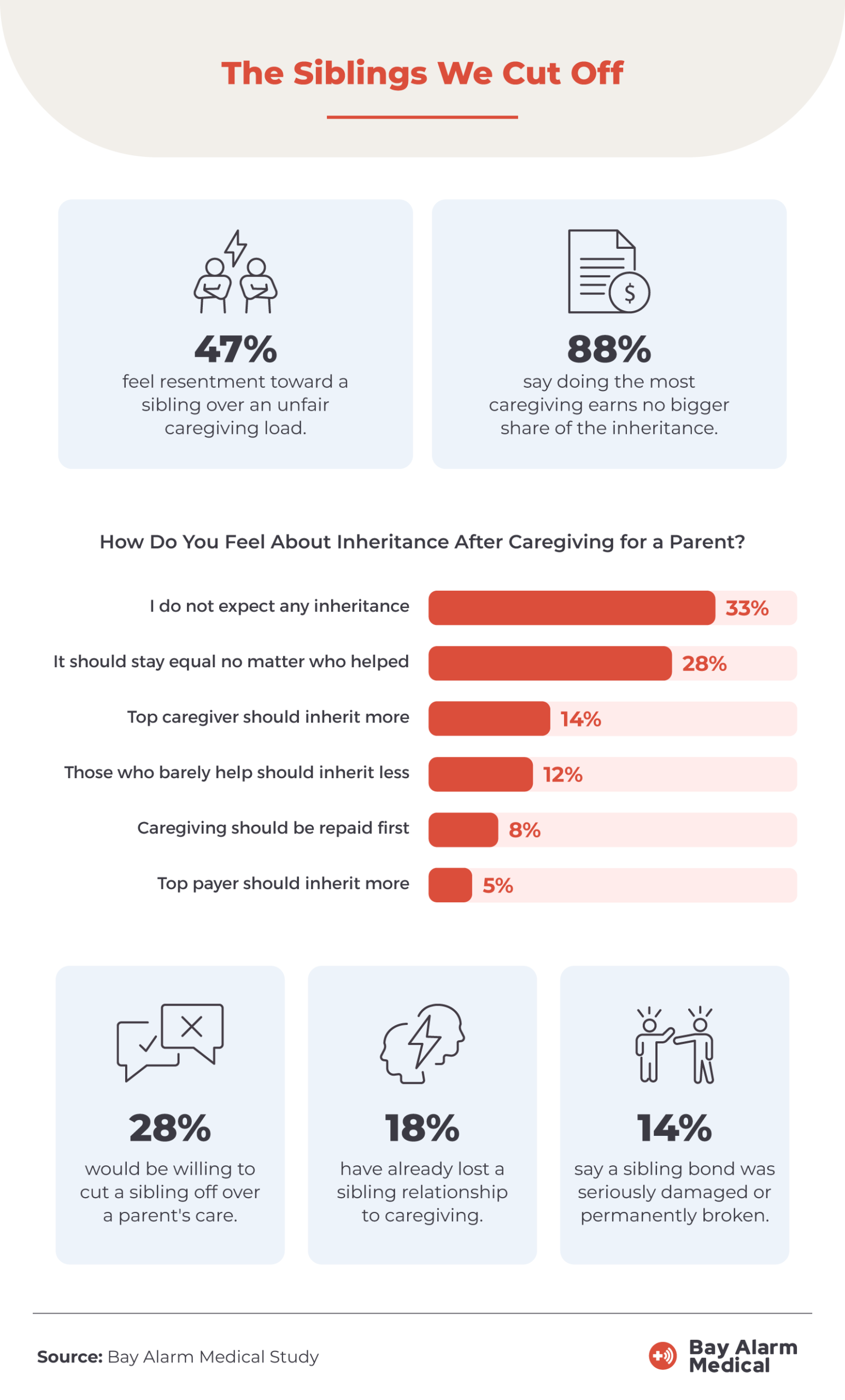
Resentment is the undercurrent of unequal caregiving. Nearly half of caregivers (47%) felt resentment toward a sibling over an unfair load, with Gen X most likely to feel it (52%) and Gen Z the least likely (38%). Daughters carried more of that bitterness than sons, at 52% versus 40%.
For a meaningful share of families, the damage became permanent. Nearly a fifth of adult children (18%) had already lost a sibling relationship to caregiving, and 28% would be willing to cut a sibling off over a parent’s care. Daughters were more willing to walk away than sons, at 31% versus 25%.
Sometimes the fallout reaches the parent’s estate. Seven percent of adult children have convinced a parent to change the will or inheritance based on caregiving.
Sharing the Care Before It Divides the Family
The picture that emerges is one of love stretched thin: one sibling (often a daughter) carrying more than half the load while money and mismatched effort spark fights that spill into group chats and, too often, into permanent rifts. Caregiving may be unavoidable, but the resentment that follows an uneven split is not, and honest conversations, shared plans, and the right support tools can keep the work from falling on one person.
The families who fare best tend to decide together how care will happen long before a crisis forces the question. When the time comes to care for the people who once cared for us, the real test may not be how much we give, but whether we are willing to share the weight.
Methodology
We surveyed 1,008 U.S. adults who have at least one living sibling and who currently share or previously shared caregiving responsibilities for a parent age 65 or older. Respondents spanned four generations: Gen Z (16%), millennials (48%), Gen X (29%), and baby boomers (7%), and included 61% women and 38% men, with the remainder identifying another way or declining to answer. Data was collected in June 2026. Percentages may not sum to 100% due to rounding.
About Bay Alarm Medical
Bay Alarm Medical empowers individuals to live independently, safely, and with confidence through innovative medical alert products and services. Our commitment is to deliver compassionate, high-quality support that provides peace of mind for both users and their families. With a focus on reliability and trust, we are dedicated to enhancing well-being and supporting health for all ages.
Fair Use Statement
The findings and graphics shared here are available for noncommercial use only. If you reference or republish them, please include a link back to this page with proper attribution to Bay Alarm Medical so readers can explore the full study.